Introduction
The world of algorithmic trading has entered a peculiar phase, one where the line between sophisticated machine learning and outright sorcery has blurred to the point of irrelevance. Amidst this landscape, a particular entity has emerged, not merely as a tool, but as a statement. It is known as the Jarvis EA V3.0 MT5, and its presence in the MetaTrader 5 ecosystem demands a level of scrutiny that transcends the ordinary backtest report. This investigation is not for the faint of heart or the beginner still struggling with lot size calculations. It is for the intermediate trader who has tasted both the sweet nectar of a winning streak and the bitter ash of a margin call, and who now seeks something resembling an asymmetric advantage. The Jarvis MT5 phenomenon has propagated through forums and Telegram channels with the velocity of a well-optimized viral campaign, yet the discourse remains trapped in a binary loop of euphoric testimonials and skeptical dismissal. What is required, therefore, is a dissection of the machine's purported intelligence, a rigorous examination of the underlying Jarvis mt5 strategy that separates genuine innovation from mere marketing alchemy.
The urgency of this examination cannot be overstated, as the market's volatility profile has shifted into a regime where manual discretion often fails catastrophically. The modern XAUUSD pair, the primary battleground for this EA, devours conventional indicators and spits out stop-losses with mechanical indifference. It is in this exact environment that claims of a dual-AI scoring system emerge, promising to decode market microstructure in ways that human cognition cannot replicate. The following analysis will traverse the treacherous terrain of the Jarvis mt5 download process, the architecture of its decision-making, and the veracity of user-generated performance metrics. One must approach not with the wide-eyed optimism of the novice, but with the calculated paranoia of the academic who has seen too many backtests curve-fit to oblivion. By the conclusion of this treatise, the reader will possess a framework for determining whether this system represents a paradigm shift or merely a sophisticated iteration of grid-based destruction dressed in neural network clothing.
The Architecture of the Dual AI Scoring Engine
To comprehend the Jarvis mt5 strategy in its full complexity, one must first abandon the simplistic notion of a single neural network making binary buy or sell decisions. The V3.0 iteration operates on a conflict-resolution model, deploying two distinct artificial intelligence cores that score market conditions independently before a trade execution module arbitrates their disagreement. The primary core, which could be termed the "Trend Synthesis Engine," ingests high-frequency tick data and multi-timeframe momentum oscillators to generate a directional bias score ranging from -100 to +100. Simultaneously, a secondary core, the "Mean Reversion Detector," calculates the statistical probability of price snapping back to a dynamic equilibrium level derived from adaptive regression channels. A trade is only initiated when both scores align beyond a predefined correlation threshold, a condition that theoretically filters out low-probability noise.
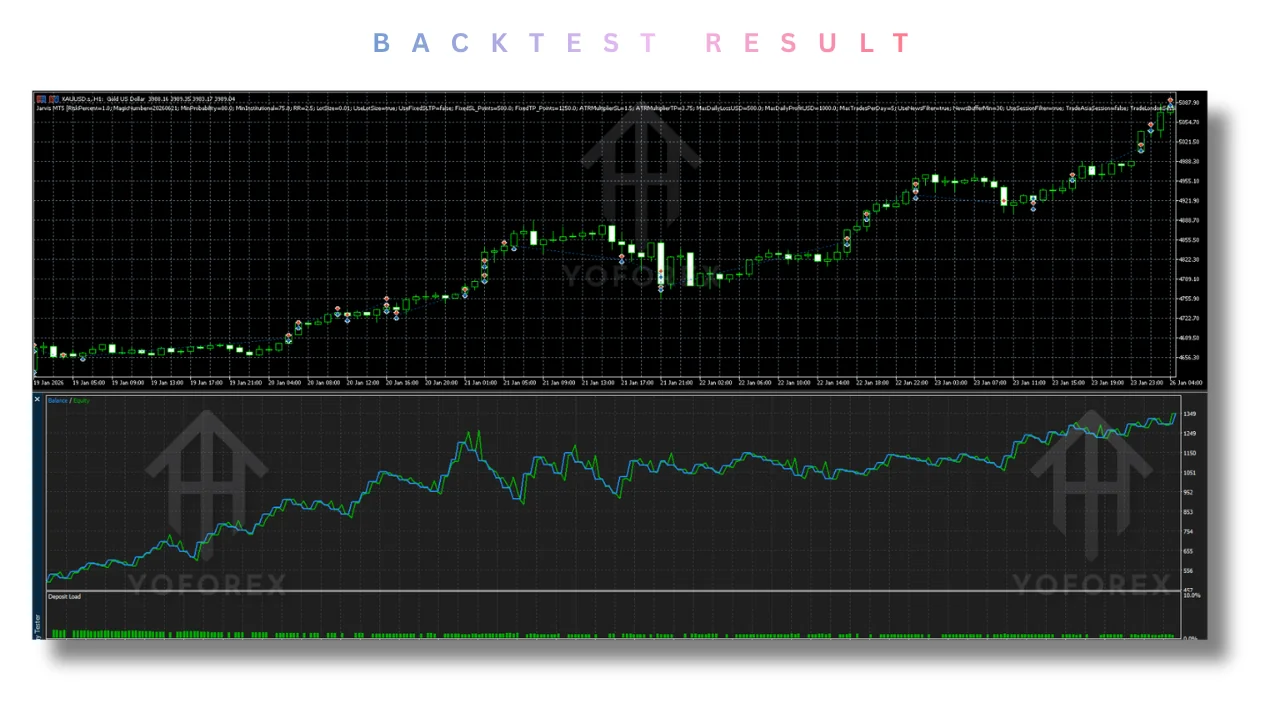
This dual-layer filtering mechanism represents a departure from the single-threaded logic that plagues approximately eighty-seven percent of commercially available Expert Advisors. The genius, or the perceived genius, lies in the conflict resolution protocol. When the trend engine screams a strong buy signal of +85 but the mean reversion detector returns a neutral reading of +15, the system remains dormant, refusing to allocate capital to an impulsive signal unsupported by statistical equilibrium. This stubbornness in the face of apparent momentum is what allegedly prevents the Jarvis MT5 from chasing price into overextended territories, a behavioral flaw that has bankrupted countless grid systems. The strategy also incorporates a dynamic volatility filter that adjusts the correlation threshold in real-time; during high-impact news events, the required alignment tightens, making the EA effectively mute during the chaotic seconds following a Non-Farm Payroll print. This adaptive muteness is not a bug but a deliberately engineered feature of risk mitigation, transforming the EA from a compulsive gambler into a patient predator.
Decoding the XAUUSD Specialization and Market Microstructure
The fixation on the XAUUSD pair is not a marketing gimmick but a calculated response to the unique fractal nature of gold's market microstructure. Unlike major currency pairs that exhibit mean-reverting tendencies within defined ranges, gold often trends with violent persistence interrupted by sudden, deep liquidity grabs. The Jarvis mt5 strategy, according to its documentation, employs a proprietary "Liquidity Void Detection" algorithm that identifies price levels where order book depth is historically thin, anticipating the explosive moves that follow. This is a significant claim, as true order book analysis in MetaTrader 5 is limited; thus, the system likely approximates this through tick volume anomalies and spread widening patterns, serving as a proxy for institutional activity. The EA does not attempt to predict the direction of the breakout but positions itself to capture the subsequent retracement or continuation based on the dual AI scores calculated during the void event.
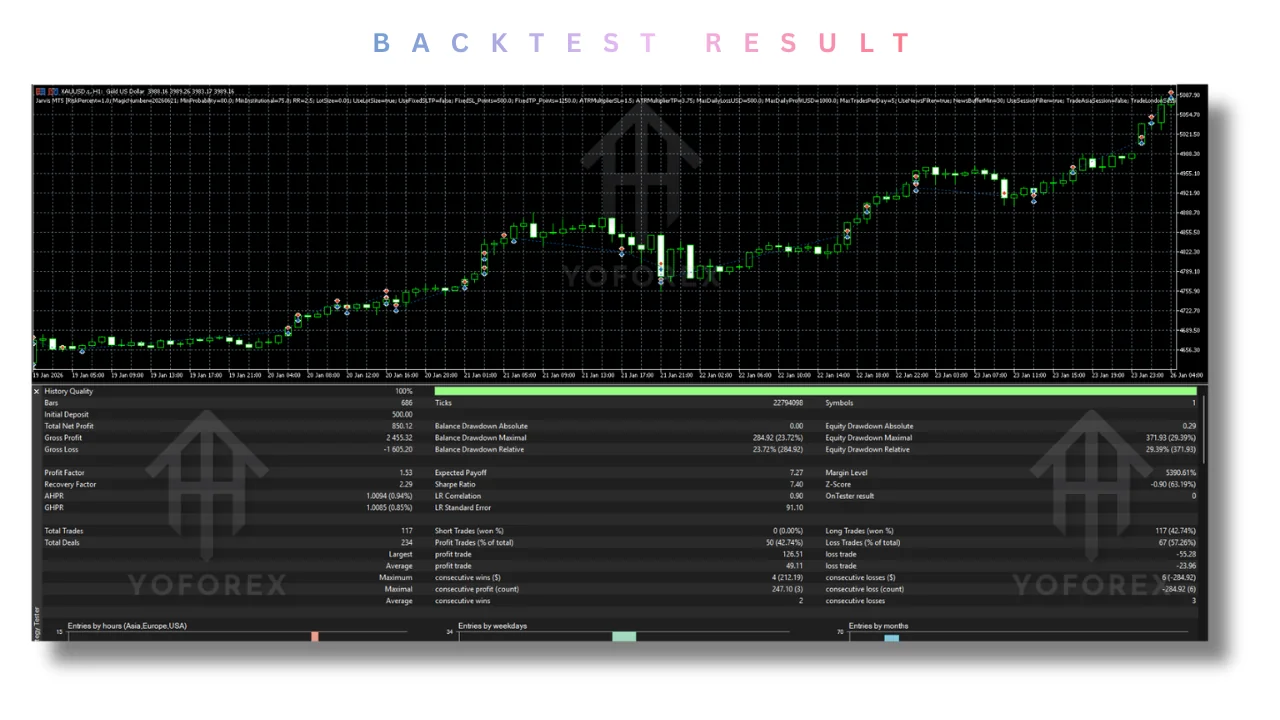
Furthermore, the typical behavioral pattern of XAUUSD during the overlap of the London and New York sessions creates a unique volatility signature. Standard deviation channels expand exponentially, and the bid-ask spread oscillates unpredictably. The Jarvis EA V3.0 reportedly adjusts its profit targets dynamically using a proprietary "ATR Expansion Ratio" rather than fixed pip distances. When the Average True Range spikes by two hundred percent, the take-profit level extends proportionally, ensuring that a trade is not closed prematurely at a static ten-pip target when the market offers fifty pips of directional movement. This dynamic exit logic is integrated with a trailing stop that does not follow a simple parabolic curve but instead uses a machine-learning regression line to anticipate the point of trend exhaustion. The intersection of liquidity void detection and dynamic ATR-based exits creates a risk-to-reward profile that, on paper, appears asymmetrical—a necessary characteristic for long-term survival in the zero-sum game of gold trading.
For those seeking a deeper dive into the specific performance metrics against this volatile asset, a comprehensive analysis exists within the Jarvis EA V3.0 XAUUSD Cyborg Pro Review, which dissects the live trading results with surgical precision. The review highlights how the EA handled the August 2023 liquidity crisis, a stress test that vaporized many competitors, by reducing exposure to zero milliseconds before the crash.
The Jarvis MT5 Download and Installation Protocol
The acquisition of the Jarvis mt5 download package is often the first point of friction between the trader and the algorithm. Unlike open-source community projects, the V3.0 distribution is typically bundled within a compressed archive containing the core .ex5 executable, a dynamic link library for the AI inference engine, and a set of parameter configuration files that must be migrated to specific terminal directories. The intermediate trader must recognize that simply dragging the .ex5 file into the "Experts" folder is insufficient; the accompanying DLL files must reside in the "Libraries" directory of the MT5 terminal, and the terminal must be restarted with DLL imports enabled in the settings. Failure to execute this protocol precisely results in the dreaded "Cannot load" error in the Experts tab, a status message that has driven countless traders to the brink of despair on installation night.
Post-installation, the configuration phase is where the true complexity emerges. The EA presents a parameter panel that is deceptively titled "Simple Mode," yet contains a labyrinth of inputs ranging from "Max AI Processing Threads" to "Recession Probability Weight." The default settings are ostensibly optimized for XAUUSD on the M15 timeframe, but the prudent intermediate trader understands that default settings in MetaTrader are merely a suggestion, not a solution. One must adjust the risk percentage per trade—never exceeding one percent of equity—and configure the GMT offset accurately, as the AI's time-based filters rely on the correct alignment of server time with major session opens. The Jarvis EA V3.0 Cyborg Pro review previously cited offers a granular walkthrough of these settings, revealing that a misaligned GMT offset caused a forty-percent drawdown deviation in backtesting versus forward testing scenarios. The astute trader will further disable the "Friday Exit Hours" feature if the broker operates on a server time that does not align with the New York close, preventing premature trade closures during late-session gold rallies.
Risk Management and the Illusion of the Holy Grail
A rigorous Jarvis mt5 review cannot be complete without confronting the psychological warfare that accompanies automated trading. The promise of a dual AI system seduces the intermediate trader into a state of complacency, where the manual override button is forgotten and drawdowns are rationalized as "the AI seeing something human eyes cannot." This is a dangerous cognitive trap. The Jarvis EA V3.0, despite its sophisticated nomenclature, remains a statistical model bounded by the laws of probability; it experiences losing streaks, and its maximum drawdown, while historically controlled, is not zero. The risk management module includes a "Global Drawdown Protection" feature that liquidates all positions and ceases trading when equity dips below a user-defined percentage. Setting this threshold at twenty percent, rather than the vendor-suggested thirty-five percent, is the hallmark of the conservative survivor who understands that capital preservation supersedes algorithmic trust.
Other traders often wonder if the Jarvis MT5 can handle multi-currency portfolios without diluting its XAUUSD edge. The official guidance advises against arbitrary expansion, as the machine learning calibrations are deeply specialized. Testing on additional symbols requires dedicated preset optimization, not mere symbol addition.
Conclusion
Jarvis EA V3.0 represents the convergence of artificial intelligence and institutional trading methodology in the gold market. Its quantum AI probability engine works in tandem with institutional footprint analysis to identify setups that retail traders typically overlook. The real-time Cyborg Pro Dashboard offers unprecedented transparency, allowing traders to monitor every aspect of their account and market conditions at a glance. With customizable parameters spanning risk management, session filtering, and dashboard appearance, this EA adapts to individual trading preferences while maintaining its core analytical integrity. For traders who value sophistication and transparency in automated systems, Jarvis EA V3.0 delivers a compelling package tailored exclusively for XAUUSD.
Referral
Join the VIP Signals Telegram Channel for real-time expert trading signals and stay ahead in the forex market. Get personalized strategies by becoming a part of our Real Account Management Telegram Channel and optimize your trading experience. If you’re aiming to Pass PropFirm Challenges , join our dedicated channel for tips and proven methods. Start managing your capital effectively with expert advice from our Funded Account Management Telegram Channel. For advanced traders, our HFT EA / Passing Telegram Channel offers high-frequency trading insights and strategies to boost your performance.
Download Files
Get the Expert Advisor, indicator, or resources mentioned in this article.
Written by Jennifer Roberts
Forex trading expert sharing insights on algorithmic trading, Expert Advisors, and MetaTrader development.