
Introduction
Navigating the forex market demands tools that simplify complex price dynamics while delivering actionable insights. The Support and Resistance TLB OC v02 Indicator for MetaTrader 4 (MT4) is a standout solution, empowering traders to identify critical price levels with unmatched clarity. Built on the innovative Three Line Break (TLB) methodology, this indicator dynamically plots support and resistance zones, helping traders anticipate reversals, breakouts, and consolidations. Launched as a free, open-source tool, its .mq4 format allows customization, making it a favorite among forex enthusiasts in 2025. Ideal for scalpers, swing traders, and long-term investors, the TLB OC v02 enhances decision-making across all skill levels. This blog explores its mechanics, unique advantages, reasons to adopt it, and optimal strategies for mastering the forex market.
How It Works
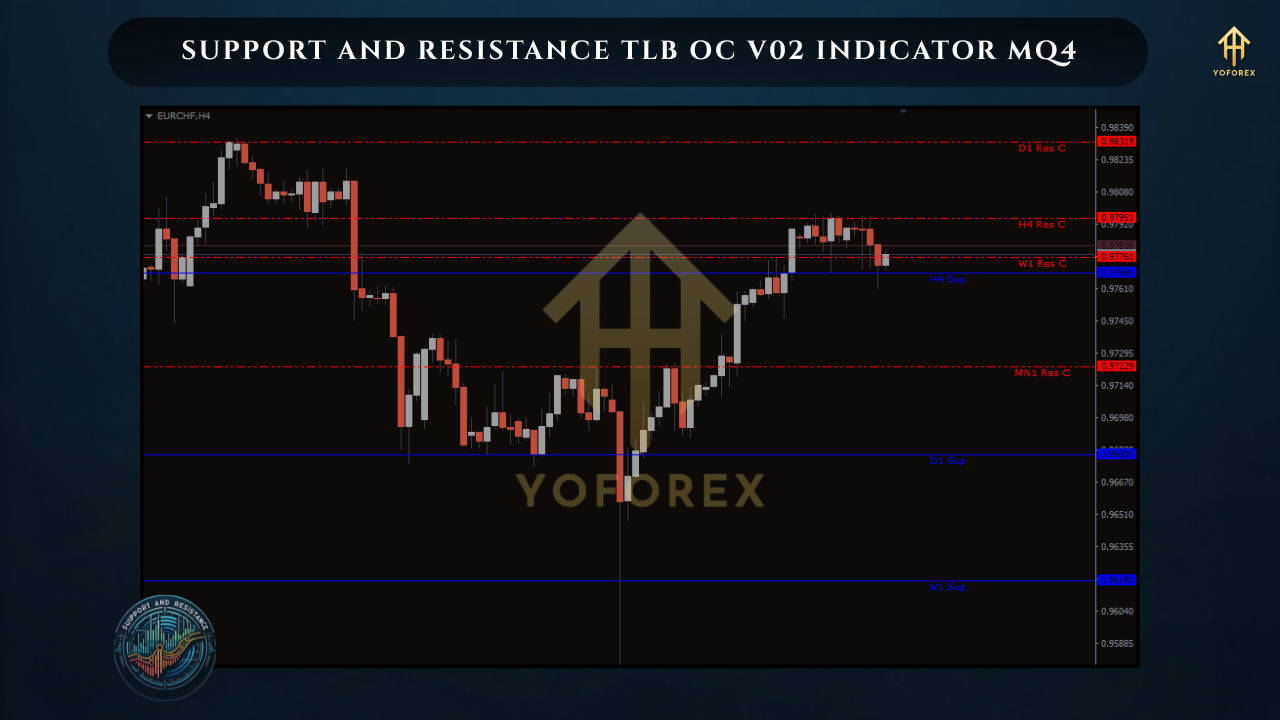
The Support and Resistance TLB OC v02 Indicator operates by analyzing price action through the Three Line Break framework, which prioritizes significant price movements over time-based intervals. Available in .mq4 (source code) and .ex4 (compiled) formats, it’s easily installed by placing the files in MT4’s “Indicators” folder via the “Mql4” directory and restarting the platform. Once activated, the indicator scans historical price data, using a customizable lookback period (e.g., LB=20) to detect swing highs and lows, plotting horizontal lines at key support and resistance levels. These lines are drawn based on closing prices, reducing noise from wick fluctuations and highlighting zones where price is likely to react.
The indicator supports all currency pairs and timeframes, from M1 to MN1, but shines on H1 or H4 for clearer signals. Its multi-timeframe (MTF) feature allows traders to overlay higher timeframe levels (e.g., D1) on lower timeframe charts (e.g., M15), providing deeper market context. Traders can adjust settings like line thickness, colors, or lookback sensitivity to align with their strategies. The non-repainting nature ensures plotted levels remain stable, fostering confidence in trade setups. For advanced users, the open-source code enables modifications, such as adding push notifications or integrating with automated trading systems.
Why Choose Support and Resistance TLB OC v02
The TLB OC v02 Indicator excels due to its precision and flexibility. Unlike overcrowded indicators, it filters out minor price fluctuations, presenting only high-probability support and resistance zones. Its TLB-based approach ensures levels reflect genuine market turning points, making it ideal for strategies relying on price action or trend analysis. The MTF functionality offers a strategic edge, allowing traders to align short-term trades with broader market trends. Its open-source availability empowers coders to enhance features, such as adding alerts for level breaches, while its free distribution on platforms like Forex Station ensures accessibility.

The indicator’s versatility suits various trading styles, from rapid scalping to patient swing trading, and its compatibility with all pairs enhances its utility. Beginners benefit from its straightforward setup, requiring no prior coding knowledge, while professionals leverage its customization for tailored applications. Community reviews praise its reliability, particularly for binary options and forex breakout strategies. In 2025, where market volatility demands robust tools, the TLB OC v02’s low-maintenance design and proven performance make it a go-to choice for traders seeking consistency and clarity.
Best Strategy for Success
To harness the Support and Resistance TLB OC v02 Indicator effectively, traders should follow a structured approach. Begin by testing it on a demo account with a major pair like GBP/USD on the H1 timeframe. Set the lookback period to 15-25 to capture significant levels without overcrowding the chart. Combine the indicator with complementary tools, such as RSI for overbought/oversold confirmation or candlestick patterns (e.g., doji at resistance) for entry signals. For reversal trades, enter when price rejects a level with strong momentum, placing stop-loss orders 5-10 pips beyond the zone and targeting a 1:3 risk-reward ratio.
Leverage the MTF feature by aligning trades with higher timeframe levels; for instance, a buy on M15 is more reliable if it coincides with D1 support. Avoid trading during volatile news releases, like central bank announcements, to prevent whipsaws. Backtest the indicator using MT4’s Strategy Tester with real tick data to fine-tune settings for your broker’s spreads. Monitor performance biweekly, adjusting the lookback period or timeframe based on market conditions. Engage with forex communities on platforms like Forex Factory to exchange setup ideas and updates. By maintaining disciplined risk management and regularly withdrawing profits, traders can maximize the TLB OC v02’s potential for steady, long-term gains.


Comments
No comments yet. Be the first to comment!
Leave a Comment